A lot of Winnipeg renters hear “Rent Assist” and assume it’s only for people already on welfare. That assumption alone probably keeps a good chunk of eligible people, retail workers, retirees, students’ single parents, people between contracts, from ever filling out the form. Manitoba actually runs Rent Assist as two separate doors into the same program, and the one most people never look at is open to almost anyone renting in the private market on a modest income, job or no job.
Rent Assist is a monthly shelter benefit run by Manitoba Families. If you already receive Employment and Income Assistance (EIA), it’s added to your file automatically. If you don’t receive EIA, you can apply for it on your own as long as you’re a Canadian citizen or permanent resident, at least 18, paying rent (or room and board) in the private market, and your household’s net income falls under the limit set for your family size.
Two Different Ways to Qualify: EIA and Non-EIA Rent Assist
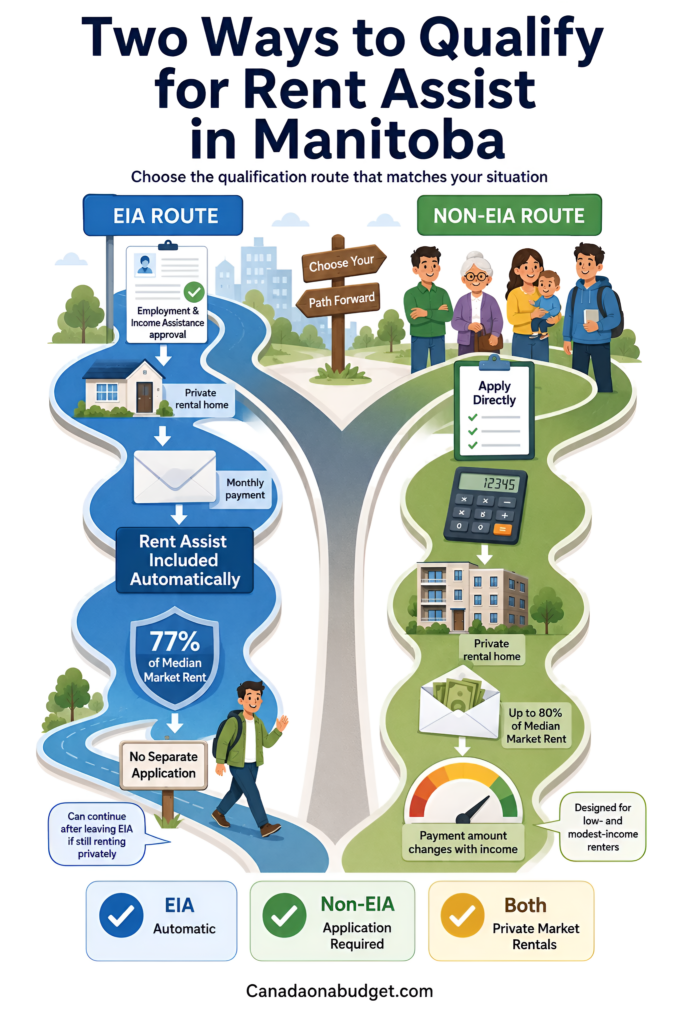
The EIA stream is the simpler of the two. If you’re approved for Employment and Income Assistance and you rent privately, Rent Assist gets folded into your monthly payment without a separate application, and you’re automatically bumped to the maximum benefit no matter what your actual rent happens to be. That maximum has been raised over the past few years and currently sits at 77 per cent of median market rent for your household size. It’s also portable: leave EIA for a job or a training program and, as long as you’re still renting privately, you can keep receiving Rent Assist on the non-EIA terms.
The non-EIA stream is the one that surprises people, because it exists specifically for renters who are working, in a training program, or living on pension income and still can’t comfortably cover rent. It pays up to 80 per cent of median market rent, calculated against your income, rather than handing out one flat maximum. That five-point gap between the two streams (77 per cent versus 80 per cent) rarely shows up in general summaries of the program, but it matters if you’re weighing whether staying on or off EIA changes what you’d actually receive.
The Income Limits for Non-EIA Rent Assist
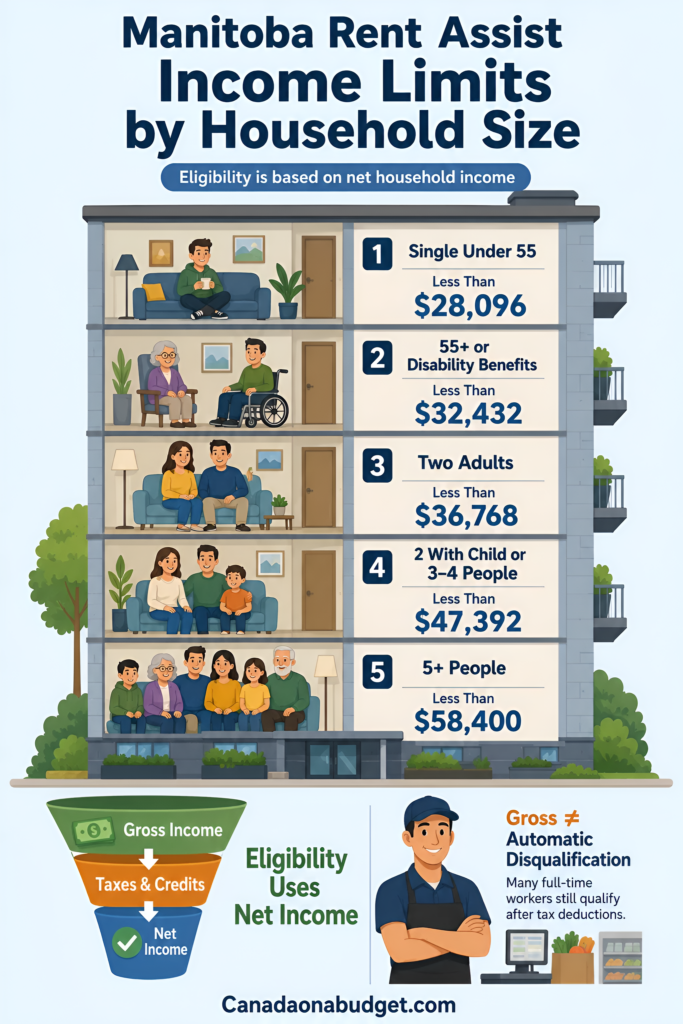
To qualify for non-EIA Rent Assist, your household’s net annual income has to fall under these thresholds, confirmed against Manitoba’s Employment and Income Assistance Regulation:
- Single, under 55: less than $28,096
- Single, 55 or older, or qualifying for the Disability Tax Credit or receiving Canada Pension Plan Disability benefits: less than $32,432
- Two adults with no dependent children: less than $36,768
- Two people including a dependent child, or three to four people: less than $47,392
- Five or more people: less than $58,400
These are net figures, meaning what’s left after deductions and credits, not your gross pay. That distinction matters more than it looks. At Manitoba’s current minimum wage of $16.00 an hour (rising to $16.40 on October 1, 2026), a single person working a full 40-hour week grosses close to $33,280 a year before anything comes off, which sits above the $28,096 cutoff on paper. Net income after tax deductions and credits is typically meaningfully lower than that gross figure, which is exactly why plenty of full-time workers still land under the threshold once their tax return does the actual math. Don’t rule yourself out just because your paycheque looks too high; run the numbers using your net income, not your hourly rate.
Who Doesn’t Qualify
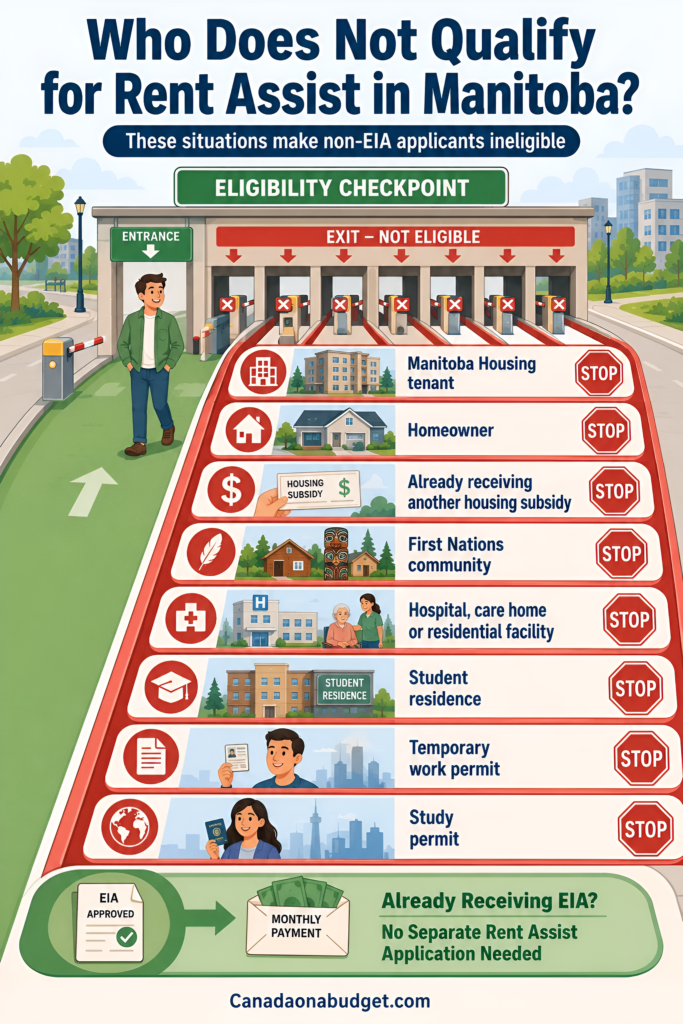
Even under the net income limits, you won’t qualify for non-EIA Rent Assist if any of the following apply: you already rent from Manitoba Housing, you own your home, you or your unit already receives another housing subsidy or benefit, you live in a First Nations community, you live in a personal care home, hospital, or residential care facility, you live in student housing, or you’re in Canada on a work or study permit rather than as a citizen or permanent resident. If you’re already receiving EIA, you don’t need to apply for non-EIA Rent Assist separately, it’s already built into your file.
How Manitoba Calculates Your Monthly Payment
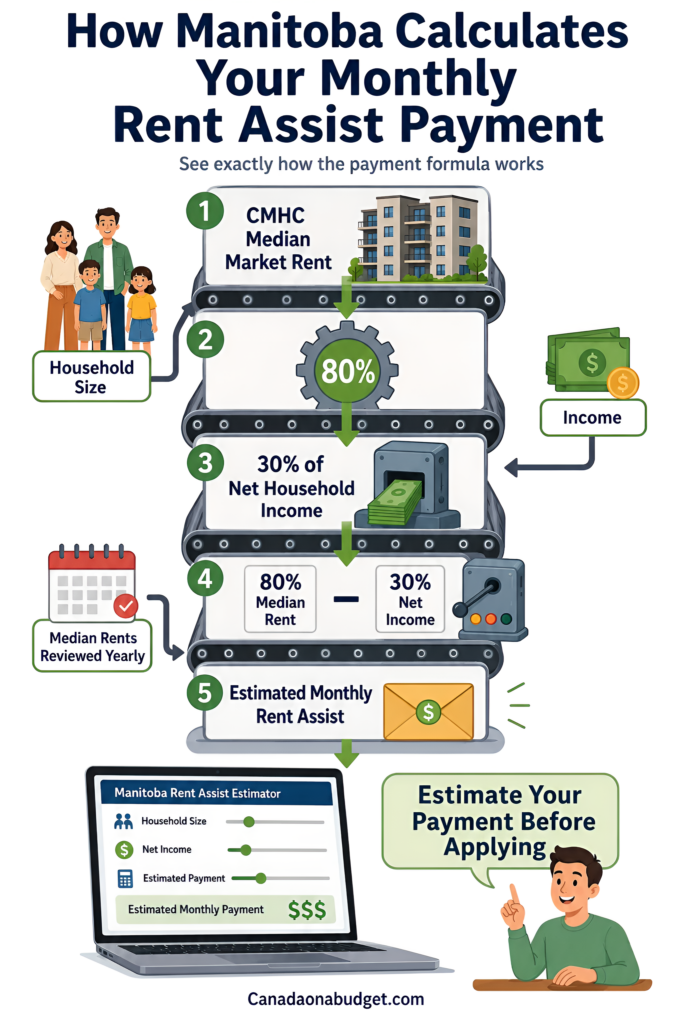
For non-EIA applicants, the formula is straightforward once you see it laid out: your benefit equals 80 per cent of the median market rent for your household size, minus 30 per cent of your net household income. The median market rent itself isn’t set by the province directly, it comes from the Canada Mortgage and Housing Corporation’s annual rental market survey, and it’s adjusted through regulation each year to keep pace with actual rents rather than staying frozen. That means your payment can shift from one year to the next even if your income doesn’t move at all, simply because rents in your area did.
Rather than guessing at your own number, run it through Manitoba’s Rent Assist estimator, which asks for your household size, income, and a few other details and gives you a realistic monthly figure before you commit to filling out a full application.
The Tax-Year Timing Rule That Trips People Up
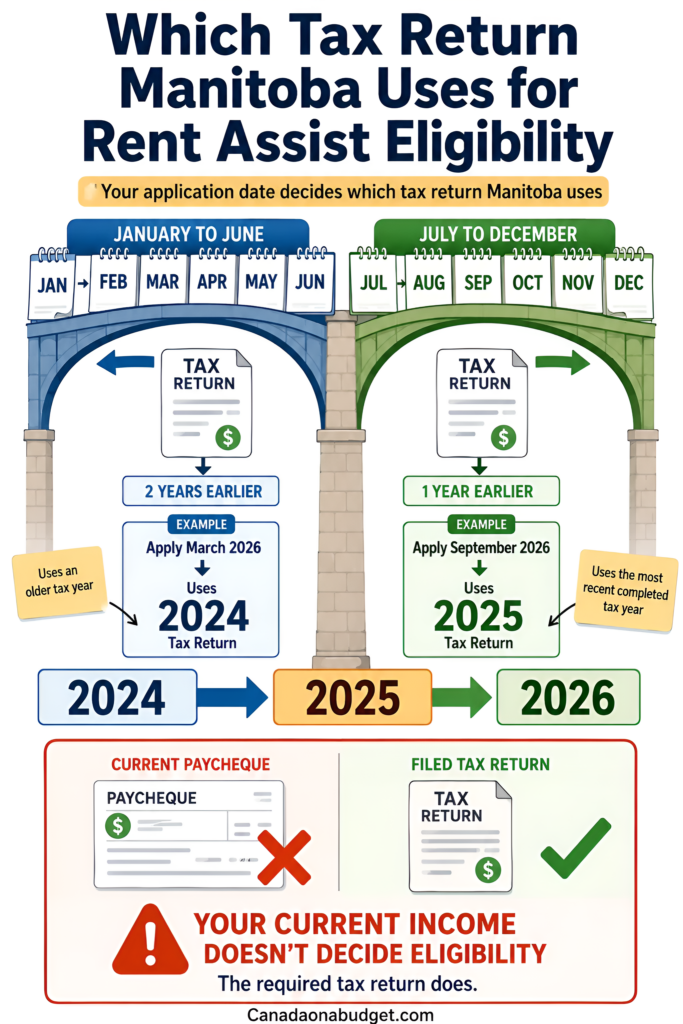
Manitoba doesn’t use your current income to decide eligibility, it uses a specific past tax return, and which one depends entirely on when you apply. Apply between January and June, and your eligibility gets calculated from your tax return from two years earlier. Apply between July and December, and it’s based on the return from just one year earlier. So someone applying in March 2026 would be assessed on their 2024 return, while someone applying in September 2026 would be assessed on their 2025 return. It’s worth knowing this before you apply, because a strong income year that’s now behind you, or a rough one, can follow you into your eligibility window longer than you’d expect.
How to Apply
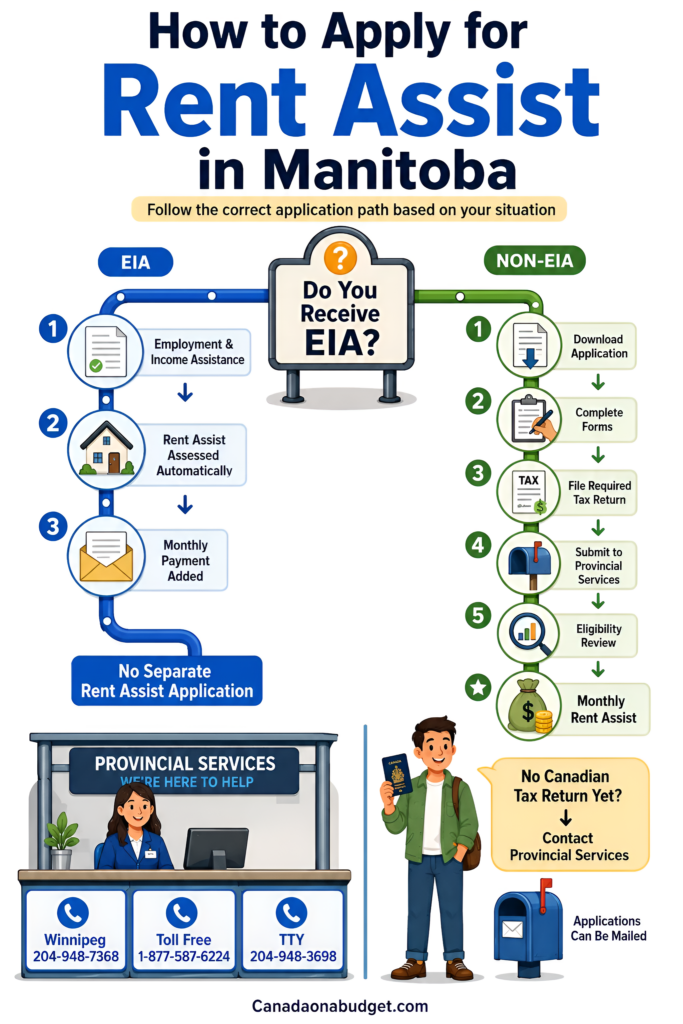
If you’re already on or applying for EIA, there’s nothing extra to do. Your Rent Assist eligibility gets assessed as part of your regular EIA application, and once approved, the benefit shows up folded into your monthly payment.
If you’re not on EIA, you’ll need to apply directly to Provincial Services. You can download the application form from the Rent Assist program page, or call to have one mailed to you:
- Phone: 204-948-7368 (Winnipeg)
- Toll free: 1-877-587-6224
- TTY: 204-948-3698
Once your form is in, you’ll need to have filed the relevant year’s tax return (see the timing rule above), since that return is what Provincial Services uses to verify your income. If you’ve just arrived in Canada and haven’t filed a Canadian tax return yet, call Provincial Services directly rather than assuming you’re stuck waiting a full year; they have a process for verifying income using other documentation in that situation.
Keeping Your Rent Assist Once You Have It
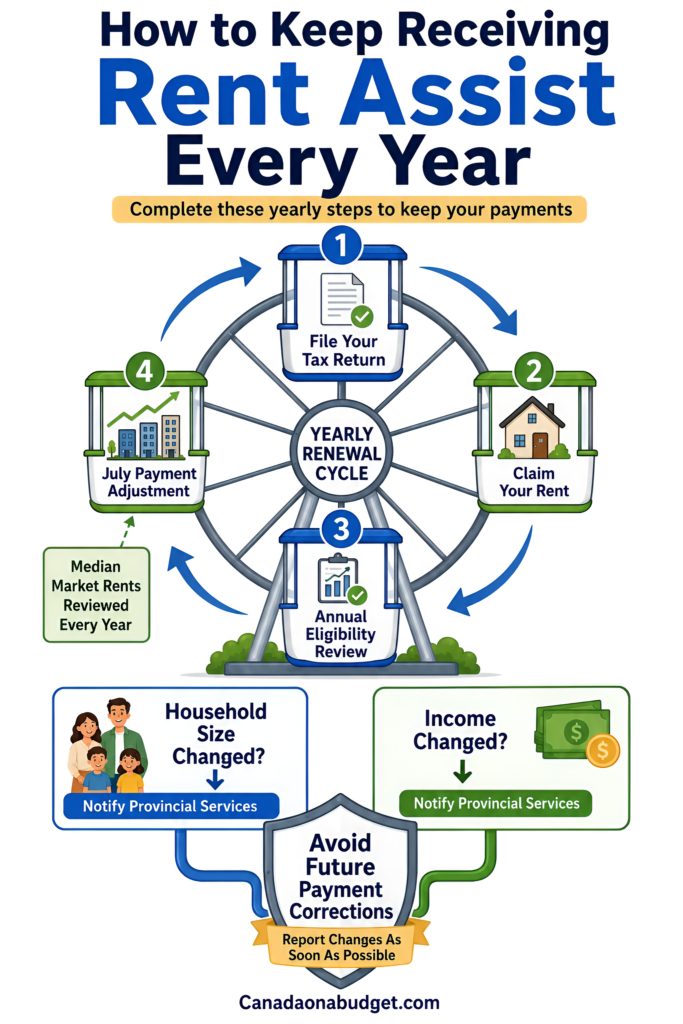
Rent Assist isn’t a one-time approval. Your eligibility gets reassessed every year based on the income reported on your tax return, so you need to claim rent on your taxes annually to stay on the program, even in a year where your income doesn’t change much. On top of that, benefit amounts themselves are reviewed each July and adjusted if median market rent has gone up, so your payment can increase from one summer to the next without you doing anything at all. If your household size or income changes partway through the year, letting Provincial Services know sooner rather than later avoids a larger correction landing on you at your next reassessment.
Common Questions About Qualifying for Rent Assist
Does Rent Assist cover room and board, not just a full apartment? Yes. The program’s eligibility rules specifically include renters paying for room and board in unsubsidized housing, not only people with a standalone lease, so a room rental arrangement can still qualify.
If I leave EIA for a job, do I lose Rent Assist right away? No. Rent Assist is built to be portable. As long as you keep renting in the private market after leaving EIA, you can continue receiving it on the non-EIA terms, with your benefit recalculated based on your income going forward.
Will my payment change if my income goes up partway through the year? Not immediately. Since eligibility is reassessed annually against your filed tax return rather than checked month to month, a raise or new job in the middle of the year typically won’t affect your payment until your next annual reassessment.
I’m 55 or older and thinking about downsizing into something smaller. Does that change my income limit? Turning 55 raises your personal income threshold if you’re applying as a single person, from $28,096 to $32,432, regardless of what size of unit you move into. It’s worth checking senior-friendly rental options alongside your Rent Assist eligibility, since the two often line up well for renters in that age bracket.
If you think you might qualify, the fastest real step isn’t reading another summary of the rules, it’s running your own numbers through the official estimator and then calling Provincial Services to start the application. From there, pairing Rent Assist with a genuinely affordable neighborhood or a lower-cost bachelor or studio unit is usually what turns the benefit into rent that’s actually manageable month to month, rather than just a smaller version of the same squeeze.